
Californian oil and gas decommissioning is a $18.4 billion black hole, new research shows
For immediate release: Thursday 20 August 2026
Californian oil and gas decommissioning is a $18.4 billion black hole, new research shows
Taxpayers facing risk of funding massive shortfall of industry decommissioning costs
Shortfall in clean-up costs caused by falling production and reduced cash flows
Report shows decline due to geology and economics, not Golden State policy decisions
Refinery sector ‘rent-seeking’ costing Californians $6 billion each year
AUSTIN, TX – The decline of oil and gas industry activity in California is leaving behind a massive decommissioning black hole totalling USD $18.4 billion, new research shows, amid falling production and reduced customer demand.
A new report has found the decline of onshore oil and gas production in California is largely due to the mature basin’s geology rather than state policies to manage the energy transition. And 20 years of declining oil demand means all refineries will close, pushing companies to maximize any last remaining profits, at significant expense to California consumers.
The declines mean the Golden State is facing a decommissioning crisis for taxpayers, researchers warn, with estimates showing industry is unable to fund most of its own $21.2 billion clean-up tab.
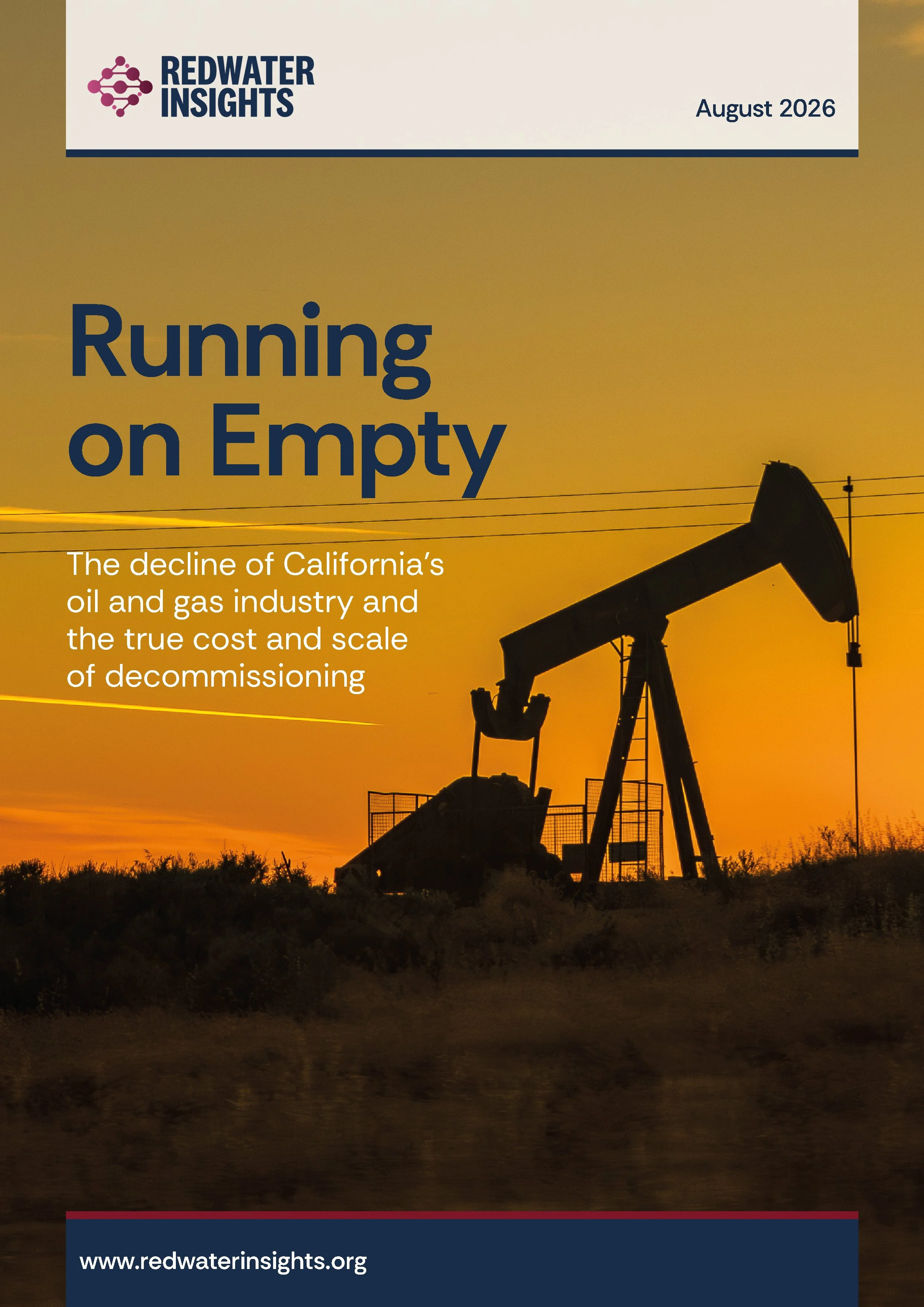
The Redwater Insights report, Running on Empty: The Decline of California’s Oil and Gas Industry and the True Cost and Scale of Decommissioning, by Dwayne Purvis and Rob Schuwerk, found the root causes to be largely geological and economic, rather than regulatory.
In May 2025, a report from Professor Michael A. Mische received widespread media headlines for claiming gas prices could rise to $8 a gallon amid refinery closures, while calling for less state regulation. The claim influenced state politics, even while refinery closures had no discernable impact on gas prices.
Key findings from the Running on Empty report launched today include:
Decommissioning costs in California have risen to an estimated $18.5 billion;
Asset retirement obligations (AROs) plus financial liabilities from just one leading company total more than $21.2 billion;
Much of the state is operating near or below its profitable limit, with only $2.1 billion cash flow available to pay off all liabilities;
Even though plugging activity has accelerated, the industry’s available cash flows have halved in just three years, resulting in a net shortfall of $18.4 billion assuming all future profit is spent on clean-up;
This net shortfall has risen by $3.2 billion in just three years, after it was last estimated at $15.2 billion in 2023;
Whereas future profits would cover 33% of outstanding liability in 2023, those dwindling profits would now cover only 13% of liability;
Refinery closures have kept in-state supply tight, allowing refiners to benefit from price spikes caused by supply shocks;
The result is a form of refinery rent-seeking causing a ‘mystery gasoline surcharge’ costing Californians about $6 billion each year, compared to other states, and up to $59 billion over the past decade; and,
Had the Benicia and Valero refineries remained open, there would be roughly 20-30% ‘excess’ capacity in California.
Report co-author Dwayne Purvis, a 30-year Petroleum Reserves Engineer and Founder of Purvis Energy Advisors, said:
“California’s upstream oil and gas industry is operating near the limit of its economic viability. Oil remains in place, but 120 years of extraction including during the very high prices of the last decade have recovered the vast majority of what can be captured economically.
“Unfortunately, the industry has not saved for the impending liability of cleaning up these formerly world-class fields, and today taxpayers are likely to inherit the majority of the end-of-life costs.”
Report co-author Rob Schuwerk, Director of Research at Redwater Insights, a data-driven research initiative analysing the risks associated with oil and gas decommissioning liabilities, said:
“Upstream and downstream, California is running on empty. Projections show the industry’s available cash flows have halved in just three years, leaving behind a $18.4 billion decommissioning black hole.
“No company has built a refinery in California since 1968, and customer demand for gasoline has been falling for 20 years. While refining shrinks, major refiners seek profits where they can find them. Unfortunately this often means keeping supply tight, forcing Californians to pay $60 billion in added gasoline costs to private companies over the past decade.
“We followed multiple lines of evidence and found that the sound and fury of state politics have had little effect on Californian crude production to date. The decline is driven by geology and economics, neither of which can be overcome with reversing state policy.
“Despite some scaremongering last year, it’s simply a false dichotomy to say that California needs less regulation as the industry declines. Further deregulation will not put more oil back in the ground, or reduce prices at the pump.”
The report highlighted the consensus around California’s energy transition already being underway, with the market’s direction of travel towards further decarbonisation.
During this transition, the legacy oil and gas industry was likely to continue trying to leverage concessions from the state, researchers noted. Without a proper plan, the state will face recurring crises and more fear-driven policymaking. Authors said state policymakers need to plan for the retirement of oil and gas to minimize the costs imposed on Californians.
The study is a follow up from the authors who researched Carbon Tracker’s There Will be Blood report in 2023, which estimated that California’s taxpayers were facing at least $15.2 billion in industry clean-up liabilities.
-ENDS-
Media contact
media@redwaterinsights.org
About Redwater Insights
Redwater Insights offers data-driven research and analysis on the financial and environmental risks associated with oil and gas clean-up and decommissioning liabilities. Our expert team combines financial, legal, data and regulatory analysis to provide sector-leading ARO insights across regulation and policy, audit and accounting, and data and analytics. We use this insight to inform and advise the industry, investors and policy makers with an aim of strengthening accountability and improving market integrity.
